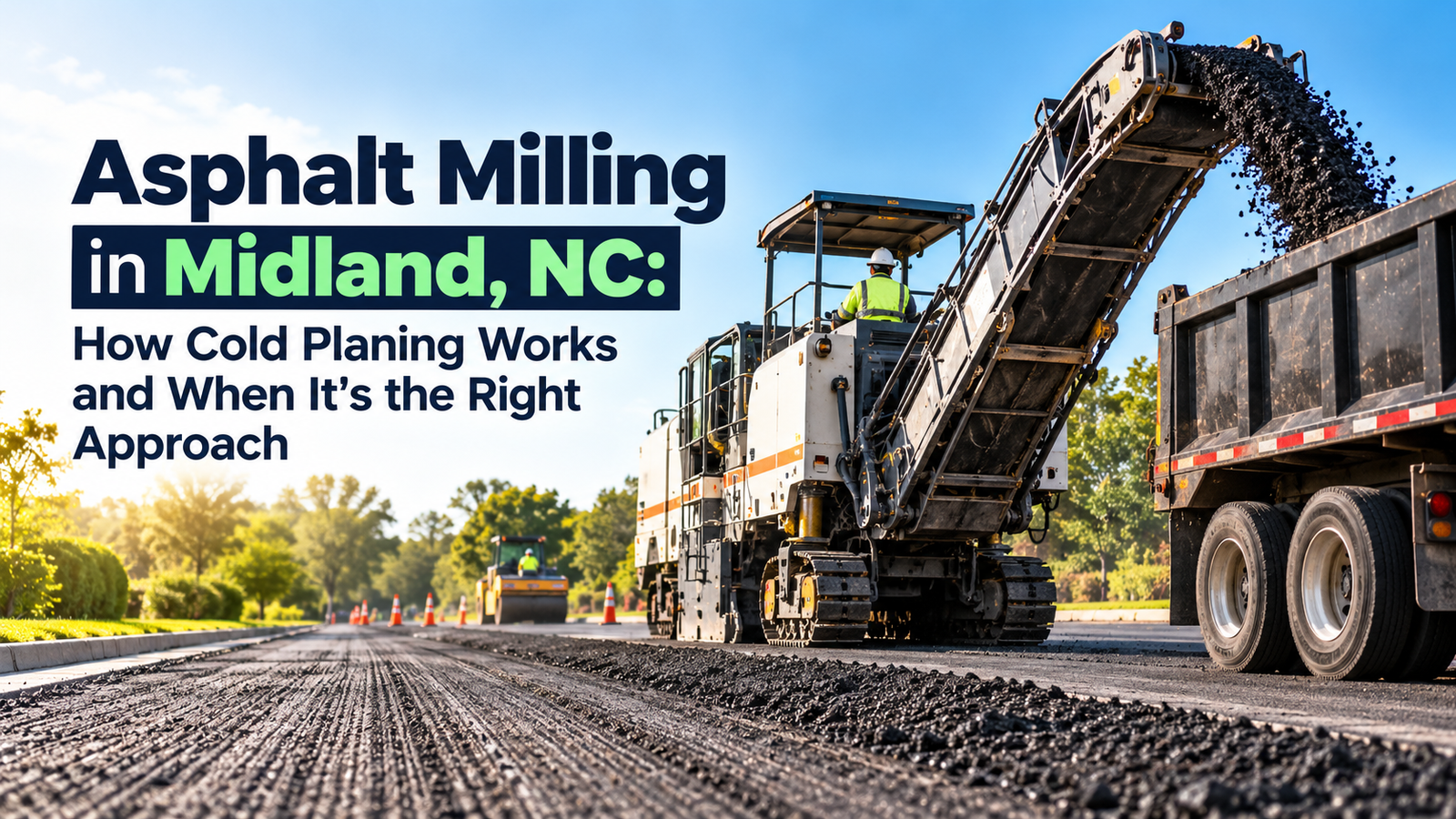
Asphalt milling also called cold planing or profiling is the process of mechanically removing a controlled depth of existing asphalt pavement from the surface using a rotating cutting drum. It is one of the most important techniques in pavement rehabilitation and is widely used across Cabarrus County and the greater Charlotte metro area for everything from resurfacing commercial parking lots to rehabilitating aging road surfaces. Understanding what milling accomplishes, when it is the appropriate treatment, and how it fits into a complete pavement rehabilitation strategy is useful knowledge for any property owner or manager dealing with aging asphalt in the Midland area.
How Asphalt Milling Works
A cold planer the machine that performs Asphalt milling Midland uses a rotating steel drum fitted with tungsten carbide cutting teeth to grind away the existing asphalt surface. The drum spins against the direction of machine travel, with the cutting teeth impacting the pavement at controlled depth. Drum width varies from small, walk-behind units capable of milling a few feet wide (used for patching and edge work) to full-lane equipment with drums 7 to 14 feet wide (used for road resurfacing and large commercial projects).
The milled material called reclaimed asphalt pavement (RAP) is picked up by a conveyor system within the cold planer and loaded directly into trucks running alongside the machine. This continuous process keeps the work area clean and the milled material moving off-site for recycling rather than accumulating on the surface. The speed of the process is one of its significant advantages: a large cold planer can remove several hundred feet of lane per hour, making it far more efficient than alternative removal methods for large-area pavement rehabilitation.
After milling, the surface left behind is textured the cutting drum leaves a corduroy pattern of parallel grooves. This texture improves the bond between the milled surface and the new asphalt overlay that follows, because the mechanical interlock created by the textured surface significantly increases adhesion compared to milling a smooth substrate.
Depth Control and Grade Correction
One of the most technically important capabilities of modern cold planers is precision depth and grade control. Automated grade control systems on cold planers use sonic sensors, slope sensors, and reference stringlines or existing pavement surfaces to maintain a specified milling depth within fractions of an inch across the entire cut. This precision enables two critical applications: uniform depth removal and grade correction.
Uniform depth removal milling to a consistent depth across a pavement surface is used when the goal is simply to remove the deteriorated surface layer before resurfacing. If a parking lot surface has extensive cracking, raveling, or oxidation but the base course beneath is still sound, milling to a depth of 1.5 to 2 inches removes the failed surface while leaving the structural base intact. Resurfacing on top of the milled surface restores the pavement to design elevation without adding unnecessary height.
Grade correction using the milling machine to reshape the pavement surface to correct drainage problems is a more sophisticated application. Pavement that has settled, deformed, or was originally paved with insufficient cross slope to shed water can be corrected by milling variable depths across the surface to establish proper drainage grades. This is particularly valuable in the Midland area, where Piedmont clay subgrades are prone to differential settlement that creates low spots and ponding areas in aging asphalt surfaces.
Why Milling Is Preferred Over Overlay Without Milling
It is technically possible to apply a new asphalt overlay directly on top of an existing pavement surface without milling first this is called a wedge-and-level overlay or a straight overlay. But in most commercial and road rehabilitation applications, milling before overlay produces significantly better long-term results.
The most practical reason is elevation management. An asphalt overlay adds 1.5 to 2 inches of thickness to the pavement surface. Without milling, this elevation increase affects curb reveal (the height of curb above pavement surface), drainage inlet elevations, handicapped ramp transitions, building thresholds, and pavement-to-utilities connections. On a typical commercial parking lot, these elevation impacts accumulate into real functional problems. Milling the existing surface to the same depth as the planned overlay keeps the final elevation consistent with the original design.
The second reason is bond quality. A new asphalt overlay bonds to the surface it sits on through a tack coat a thin film of asphalt emulsion sprayed on the existing surface before paving. Tack coat adhesion is much better on a freshly milled, textured surface than on a smooth, oxidized existing pavement, because the texture creates mechanical interlock and the milling process exposes fresh aggregate in the existing pavement that the new binder can bond to. Better interlayer bond reduces the risk of delamination a failure mode where the new overlay shears away from the existing surface under traffic loading.
The third reason is the ability to incorporate grade corrections during the milling phase. Pavement that has developed drainage problems over its service life can be corrected during milling at a fraction of the cost of addressing those problems after the new overlay is in place.
Reclaimed Asphalt Pavement: Sustainability and Recycling
The RAP produced by asphalt milling is one of the most recycled construction materials in the United States. Asphalt pavement has a near-100 percent recyclability rate milled material is collected, hauled to an asphalt plant, processed, and incorporated into new asphalt mix. The recycled content can typically constitute 20 to 40 percent of a new asphalt mix without compromising performance, reducing the demand for virgin aggregate and new asphalt binder.
North Carolina’s asphalt industry is active in RAP recycling, and NCDOT specifications allow RAP content in new mixes at approved levels. Most asphalt plants serving the Midland and Cabarrus County market accept milled material and incorporate it into production. This recycling loop keeps RAP out of landfills and reduces the carbon footprint of new pavement construction.
For property owners, this also has a practical implication: milled asphalt is a commodity, not a waste product, and haul-away of milled material may be included in the project scope rather than requiring the property owner to arrange separate disposal. The economics of RAP haul and recycling vary with market conditions, but milling does not generate a waste stream that needs landfill disposal.
Milling in the Midland Climate and Seasonal Timing
Asphalt milling can be performed in most weather conditions the cold planing process does not require heat or special atmospheric conditions the way asphalt paving does. However, milled surfaces that will not be immediately resurfaced need to be managed in wet weather to prevent RAP and aggregate from washing into storm drainage. In the Midland area, where Piedmont clay subgrades exposed by milling in low spots can become very soft when wet, it is generally preferable to sequence milling and resurfacing in close succession rather than leaving a milled surface unprotected through rain events.
The optimal paving season in North Carolina’s Piedmont runs from April through October, when ambient and pavement temperatures support proper asphalt compaction. Milling can be performed year-round, but if the resurfacing that follows requires asphalt paving, that work is generally scheduled within the warm season to ensure proper mat temperature and compaction. Cold weather paving in North Carolina is possible in the fall through early winter for small areas but carries higher risk of mat cooling too quickly for proper compaction.
Frequently Asked Questions: Asphalt Milling in Midland
What is the difference between asphalt milling and full-depth removal?
Asphalt milling removes only the surface layer or layers of the existing pavement typically 1.5 to 4 inches while leaving the base course and subgrade intact. Full-depth removal excavates the entire pavement structure including the base course, all the way to the subgrade. Milling is used when the base course is structurally sound and only the surface needs to be replaced. Full-depth removal is required when the base course has failed or when the subgrade needs improvement before rebuilding.
Can milling fix a pavement surface that has settled and holds water?
Yes grade correction milling is specifically designed to address drainage problems caused by pavement settlement, differential settlement, or original construction with insufficient cross slope. The cold planer’s automated grade control system mills variable depths across the surface to establish correct drainage grades. This is one of the most cost-effective ways to address ponding problems in a parking lot without full reconstruction.
How is the milled material (RAP) handled after milling?
Milled asphalt pavement (RAP) is loaded directly into trucks by the cold planer’s conveyor and hauled to asphalt plants, where it is processed and incorporated into new asphalt mix at 20 to 40 percent recycled content. RAP is one of the most recycled construction materials in the US. It is not a waste product requiring landfill disposal, and asphalt plants serving the Midland and Cabarrus County area regularly accept and recycle milled material.
Does a milled surface need to be repaved right away?
A milled surface can remain in service temporarily commercial properties and roads are sometimes opened to traffic on a milled surface while resurfacing work is scheduled but it is not a permanent condition. The milled texture is rough and can accelerate tire wear; the surface has lost the waterproofing provided by the original dense-graded surface, making the base more vulnerable to moisture infiltration. For commercial properties, minimizing the time between milling and resurfacing is advisable to protect the base and minimize disruption to users.